Choosing Carbide Grades for Stainless Steel Machining
Sub-micro grain, 10–12% cobalt, and a controlled edge hone — how grade selection decides whether your stainless job survives a full shift.
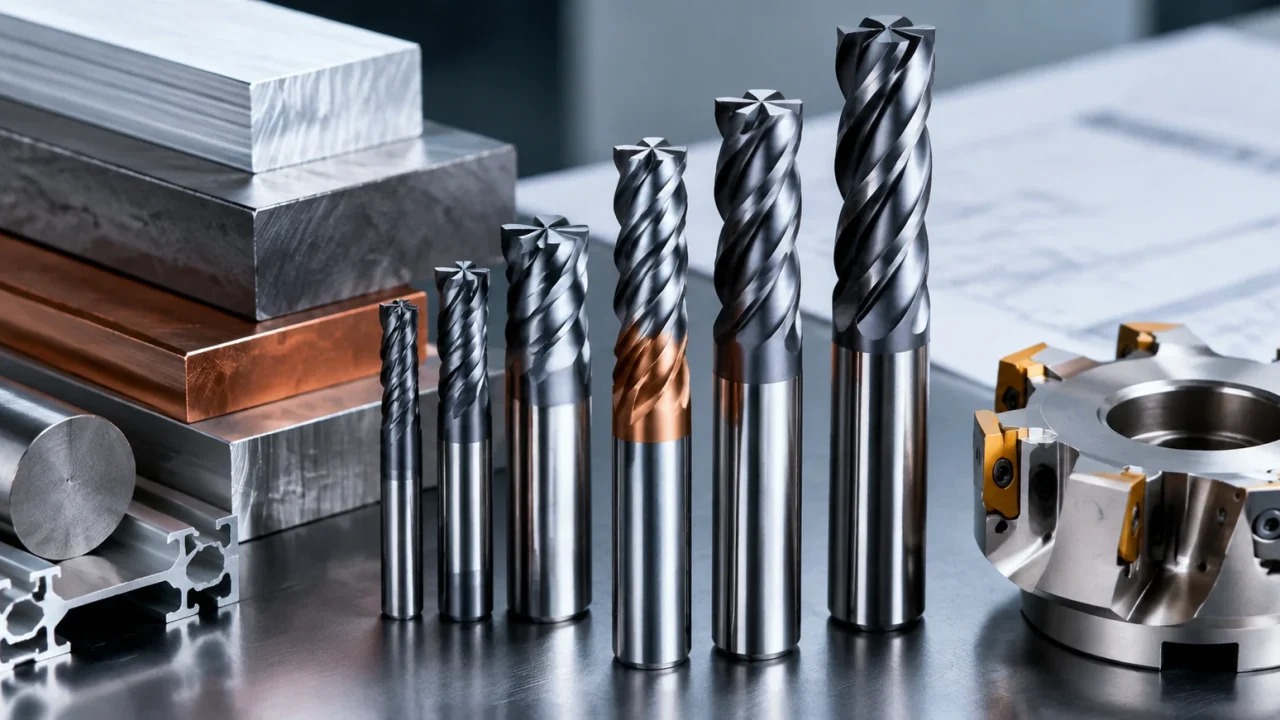
Stainless steel is where tool steel selection stops being a catalog decision and becomes an engineering one. The same geometry that runs all week in 1045 carbon steel can chip in the first ten minutes of 304 — and in most cases the problem is not the geometry. It is the grade.
What actually kills the edge in stainless
Two mechanisms dominate. First, work hardening: 304 and 316 can jump from roughly 200 HB to double that at the machined surface the moment the edge rubs instead of shears. Second, heat concentration: stainless conducts heat poorly, so instead of leaving with the chip, cutting heat stays at the edge until the coating softens and the substrate underneath follows.
A grade that survives this has to combine hot hardness with transverse rupture strength. That is why the answer is never the hardest blank on the shelf.
The grade profile that works
| Property | Target | Why |
|---|---|---|
| Grain size | 0.4–0.8 µm (sub-micro) | Fine grain holds a keener edge and resists micro-chipping on interrupted cuts |
| Cobalt content | 10–12% | Higher Co raises transverse rupture strength — the property that carries interrupted cuts in 304 |
| Hardness (HRA) | 91.5–92.5 | Enough hot hardness to protect the edge when the chip cannot carry heat away |
| TRS | ≥ 4,000 N/mm² | Insurance against the entry/exit shocks of pocketing and ramping |
Match the grade to the operation
- Contouring and pocketing in 304/316 — sub-micro grain, 12% Co. Interrupted engagement is the norm here, and toughness wins.
- Finishing passes — the same grade family, run sharper with a lighter hone (0.10–0.15 mm). Do not trade toughness you no longer need for edge life you cannot keep.
- 17-4PH and other PH grades — step up to AlCrN coating and keep the sub-micro substrate. The abrasive scale punishes coarse grains.
- Drilling — toughness again leads. A 5xD carbide drill on a 10% Co substrate outlasts a harder, more brittle grade every time in job-shop mixed stock.
What we tell our own customers
When a distributor asks us to quote tools for mixed stainless work, we quote one grade family, not four. Sub-micro grain with a controlled cobalt binder, ground on 5-axis equipment, honed to the operation. It keeps their crib simple and keeps the failure mode predictable — and a predictable failure mode is one you can correct with feed and speed instead of a purchase order.
Need grades matched to your stainless jobs? Send us the material and operation — we reply with the grade, coating and starting parameters in one working day.