Aluminium Milling: Beating Built-Up Edge
Soft, gummy aluminium welds itself to the cutting edge and drags across your finished wall. The fix is geometry and speed, not more coolant.
Built-up edge (BUE) in aluminium is a deposition problem, not a heat problem. The aluminium welds to the carbide, grows until a chunk tears away, and takes a piece of your surface with it. Shops respond by drowning the cut in coolant. That helps the chip leave — it does not stop the welding.
Why the edge welds in the first place
Aluminium bonds to almost anything under pressure and moderate temperature. Bonding starts when the edge has somewhere for the material to grip: a rough ground surface, an oxide coating the alloy likes, or — most common of all — a cutting speed low enough that the contact zone sits in the bonding temperature window.
The three-part fix
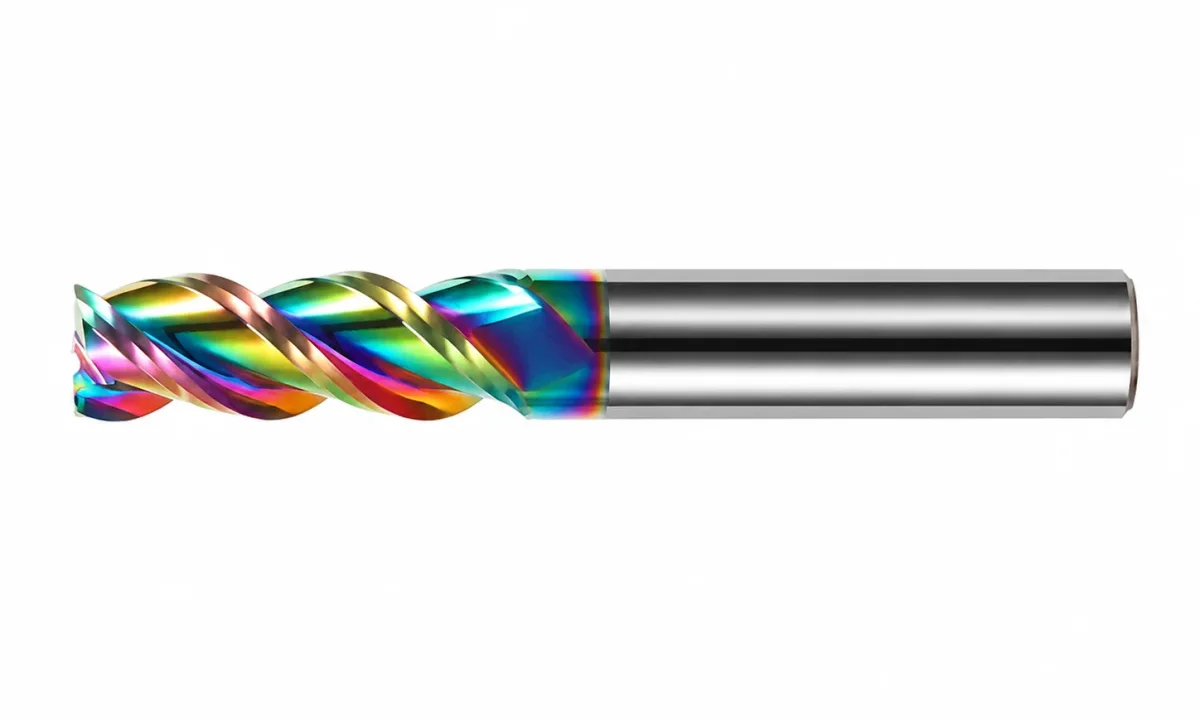
- Geometry: high helix, deep gullet, sharp polished edge. A 45–55° helix throws the chip up and out before it can sit on the flute. The edge hone that protects a stainless tool is exactly wrong here — aluminium wants the edge ground sharp and polished to near-mirror.
- Coating: uncoated bright, DLC, or nothing sticky. Standard AlTiN is an oxide ceramic — aluminium adores bonding to it. For production runs, DLC at ~0.35 µm or a bright polished flute keeps the deposition from starting.
- Speed: run away from the window. In 6061, 3-flute 12 mm tools want 500 m/min and up on a rigid machine. The single most common cause of BUE we see is a shop running half the surface speed their spindle can deliver “to be safe”.
What to check first when the finish smears
| Symptom | Likely cause | Fix |
|---|---|---|
| Smear on walls, edge looks glossy | BUE depositing and tearing | Raise surface speed 30–50%, switch to polished/DLC flute |
| Chips packed in deep pockets | Gullet too small / recutting | 3-flute high-helix tool, air blast instead of flood |
| Burr at wall exit | Edge too dull for the alloy | Sharp polished edge; reduce radial engagement on exit |
| Finish OK fresh, dies within minutes | Coating choice wrong for alloy | Move to DLC or uncoated; check coolant concentration |
Our standard answer for aluminium
3 flutes, 45–55° polished helix, ultra-fine grain 6% Co substrate, DLC or bright. In 7075 add a ZrN variant for abrasion. One drawer of these covers most aluminium work — or ask us to ground them to your drawing.