Aerospace
Titanium, superalloys and aluminium structures. Where heat stays in the cut and edge stability at temperature decides how long a tool lasts.

The problem
Aerospace alloys do not wear a cutting edge out — they destroy it. Titanium and nickel alloys keep the heat in the cut rather than in the chip, and they notch the edge at the depth-of-cut line. Thin-walled structures add deflection to the list, and documentation requirements mean the tool that made the part has to be traceable.
What we recommend
Titanium structure
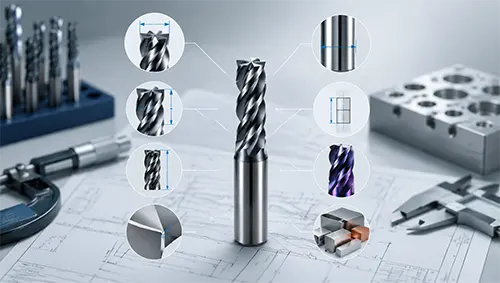
Variable helix geometry with controlled rake, so the heat leaves with the chip instead of soaking into the edge. Multilayer AlTiN coating for thermal protection.
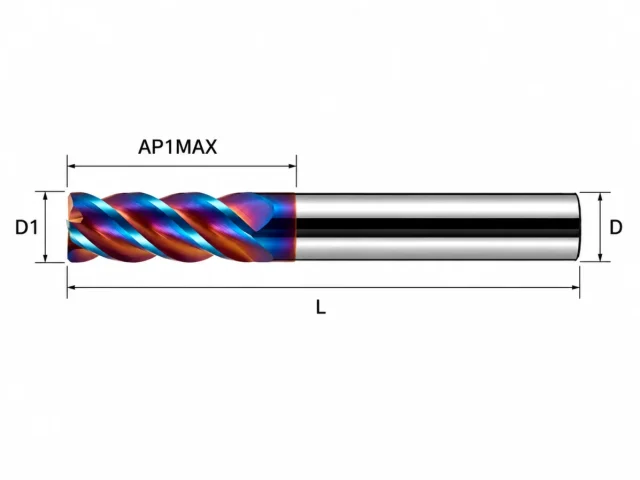
5–6 flute · variable helix · AlTiN multilayer
Nickel superalloys
Reinforced edge geometry at the notching zone, with a fine-grain substrate that holds hardness at temperature. Lower speeds, conservative feed, long tool life.
Ultra-fine K40 · AlTiN · runout < 5 µm
Aluminium structure
Polished high-helix geometry for high-speed machining. The limit here is chip clearance and workholding, not the tool.
3 flute · 45° helix · polished
Starting cutting data
| Material | Cutting speed vc | Feed fz | Depth of cut ap |
|---|---|---|---|
| Ti-6Al-4V | 50–90 m/min | 0.015–0.030 mm/tooth | 0.2×D |
| Inconel 718 | 30–60 m/min | 0.010–0.025 mm/tooth | 0.15×D |
| Aluminium 7075 | 250–450 m/min | 0.05–0.10 mm/tooth | 0.4×D |
| Stainless 17-4PH | 80–130 m/min | 0.020–0.045 mm/tooth | 0.25×D |
How to specify it
- Alloy and condition — Ti-6Al-4V annealed and Inconel 718 aged behave differently, and the geometry follows the material.
- Wall thickness and part rigidity — thin walls change the acceptable radial engagement more than the tool choice does.
- Machine spindle and coolant — through-spindle coolant, or flood? It changes what is achievable at depth.
- Traceability requirements — tell us if the order needs certificates or batch marking, and we plan it in.