Mold & Die
Hardened tool steel, deep cavities, surfaces that have to come off the machine. The geometry and coating that hold up from the first roughing pass to the last finishing pass.
The problem
A hardened cavity is the worst case for any cutting tool: the material is abrasive, the surfaces are three-dimensional, and the reach needed to get to the bottom of the cavity costs the rigidity that keeps the tool alive. Add a requirement that the surface comes off the machine without a polishing step, and the geometry has to be right from the first pass.
What we recommend
Three tools carry most of the work in a die cavity — one for each stage.
Roughing
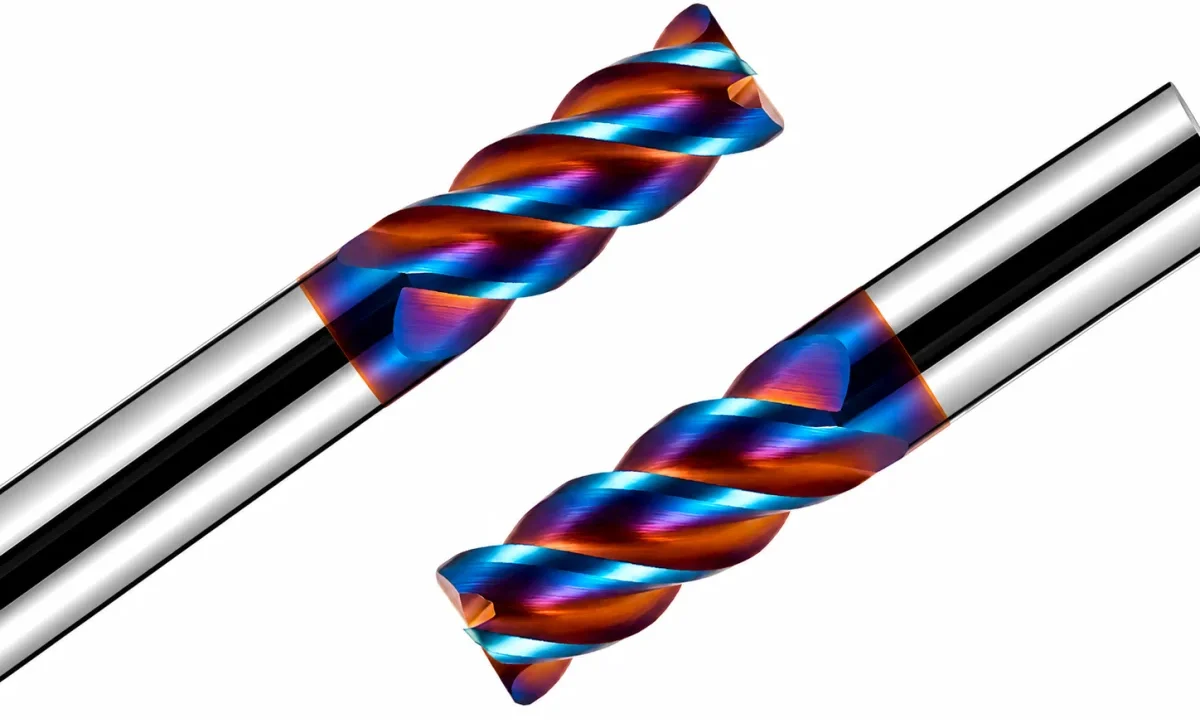
Corner radius end mills with a variable helix and an AlTiN coating. The radius protects the corner through interrupted cuts, and six flutes keep the feed rate up.
6-flute corner radius · R1.0–3.0 · AlTiN
Semi-finish
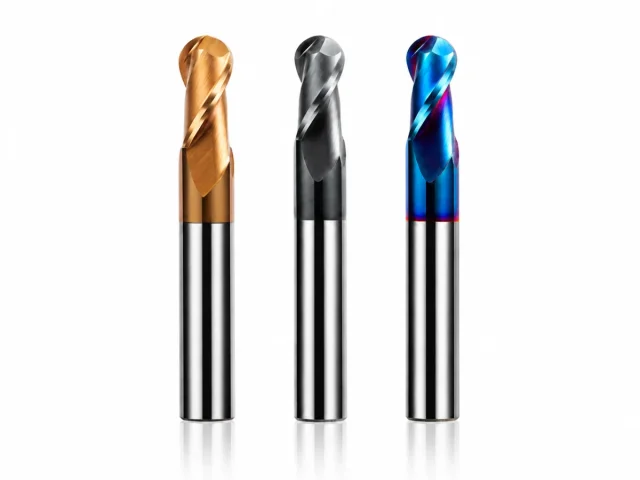
A four-flute ball nose in an ultra-fine substrate, run at a constant engagement angle. This is the pass that decides how much work is left for the finishing tool.
4-flute ball nose · AlTiN · 55–62 HRC
Finishing
A tapered ball nose, or a long-reach ball nose where the cavity is deep. The taper finishes the draft wall and the fillet in the same pass.
Tapered ball nose · 0.5°–3° · AlCrN
Starting cutting data
| Operation | Cutting speed vc | Feed fz | Depth of cut ap |
|---|---|---|---|
| Roughing 45–55 HRC | 120–180 m/min | 0.02–0.05 mm/tooth | 0.3×D |
| Semi-finish 55–62 HRC | 90–140 m/min | 0.01–0.025 mm/tooth | 0.1×D |
| Finishing 55–62 HRC | 70–110 m/min | 0.008–0.020 mm/tooth | 0.08×D |
How to specify it
- Hardness of the steel — 45 HRC and 62 HRC are different problems, and the substrate and coating change with them.
- Cavity depth and minimum internal radius — this sets the reach you need, and the reach sets the geometry.
- Surface finish required — if there is no polishing step afterwards, say so. It changes both the tool and the strategy.
- Machine and maximum spindle speed — the rpm ceiling decides how small a tool can run efficiently.
- CAM strategy — high-feed, constant engagement or conventional. Tell us which, and we quote to it.