Variable Helix Geometry: Why It Stops Chatter in Deep Pockets
Unequal flute spacing breaks the harmonic loop that turns a stable cut into a screaming one. Here is the physics, in plain language.

Chatter in deep-pocket milling is not random. It is a self-reinforcing loop: the tool deflects, the deflection changes the chip load, the changed chip load feeds the next deflection. Once the loop locks onto a natural frequency of the tool-and-spindle system, the harmonics of each tooth landing in the same wave amplify until the cut is howling.
How unequal flute spacing breaks the loop
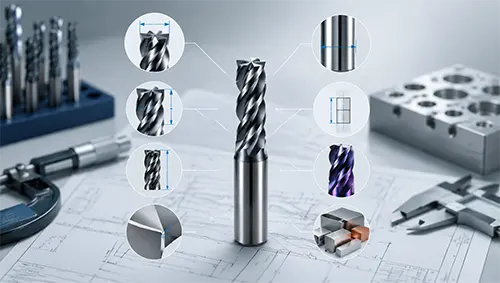
A standard end mill spaces its flutes at exactly 90° (4 flutes) or 120° (3 flutes). Every tooth hits the surface wave left by the previous one at the same phase — so the vibration repeats, cleanly, on every revolution. That regularity is what feeds the loop.
Variable helix — and its close cousin, variable pitch — staggers those angles: 88°, 92°, 87°, 93° instead of a clean 90°. Each tooth now lands at a different phase of the surface wave. The energy never sums. The loop cannot lock.
What it buys you on the floor
- Roughing in deep pockets, 3–4×D reach — the single biggest winner. Axial depths that chatter with a standard helix run quiet with a variable one.
- Thin-wall work in aluminium and steel — the workpiece is the spring; irregular tooth landing keeps from pumping it.
- Higher metal removal without raising RPM — you get stability back at the speeds your machine already runs, not at speeds you do not have.
Where a standard helix still makes sense
Variable helix slightly reduces chip room per flute and adds grinding complexity. In short-reach finishing where chatter was never a risk, a standard 45° helix with a polished flute can still be the better, cheaper tool. We manufacture both — and we will say which side of that line your job is on.
Practical starting points
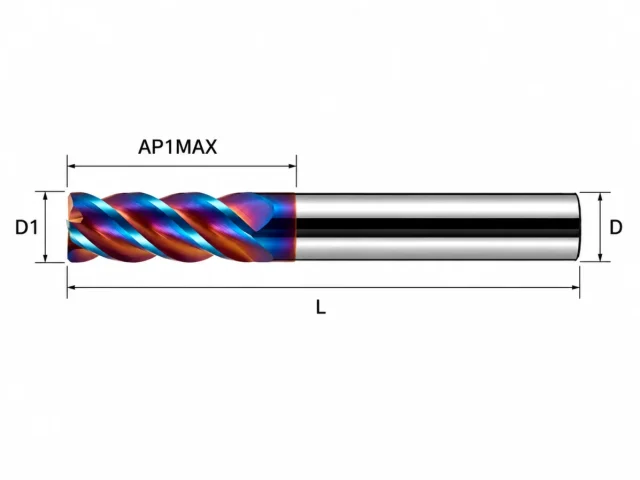
For 12 mm 4-flute variable helix tools in steel: start around 120 m/min with 0.045 mm/z, axial depth 1×D. In 304 stainless the same tool wants 90–110 m/min with flood coolant. If you are unsure whether your job needs the variable geometry, send the setup — reach, material and operation are enough for us to answer.