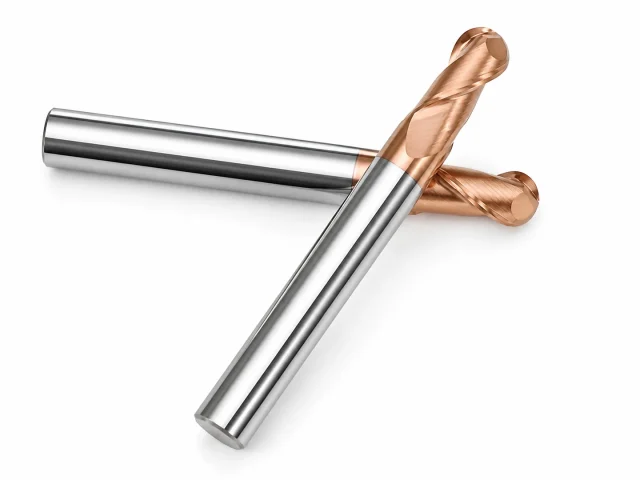
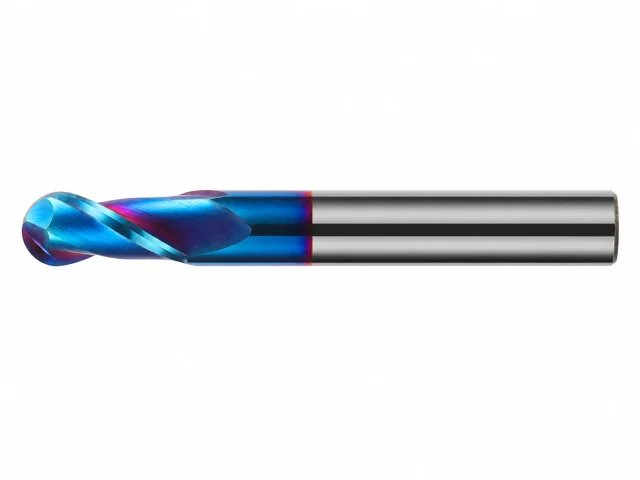
About this tool
A tapered ball nose removes the need for a separate operation on draft walls. One continuous pass down the cavity blends the fillet and the draft in a single move, and the taper adds the stiffness a straight tool would lose at that length.
Where it works
Molds, dies and electrodes where draft angles, fillets and deep ribs have to be finished in one pass.
Cutting data — starting point
Starting values for a rigid setup with a good coolant supply. Treat them as a first trial, then adjust to the machine, the holder and the actual condition of the material.
| Work material | Cutting speed vc | Feed | Depth of cut |
|---|---|---|---|
| Hardened tool steel 45–55 HRC (H) | 100–160 m/min | 0.01–0.03 mm/tooth | 0.08×D |
| Copper / graphite electrodes | 250–400 m/min | 0.02–0.06 mm/tooth | 0.1×D |
| Aluminium (N) | 300–500 m/min | 0.03–0.08 mm/tooth | 0.15×D |
What you can specify
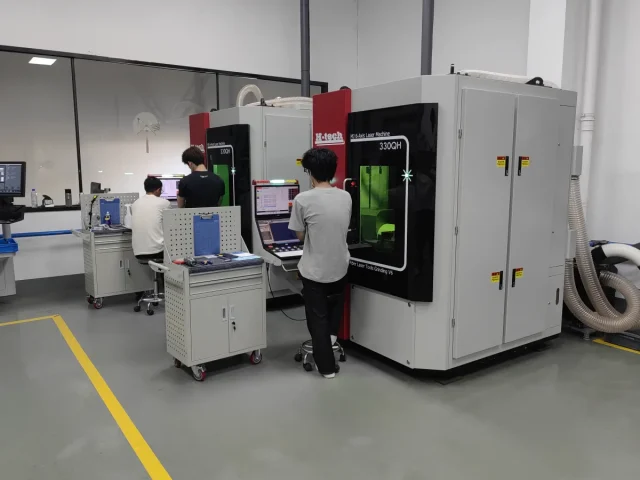
- Diameter, corner radius and flute count ground to your drawing
- Coating — AlCrN, AlTiN, TiAlN, DLC or uncoated, matched to the workpiece
- Shank — h6 ground, HA / HB / whistle-notch
- Laser-marked part number, or blank shanks for distributor stock
Not sure about the geometry? Send the drawing or a photo of the part. We recommend the profile, the coating and the starting cutting data — and quote from there.

