Medical
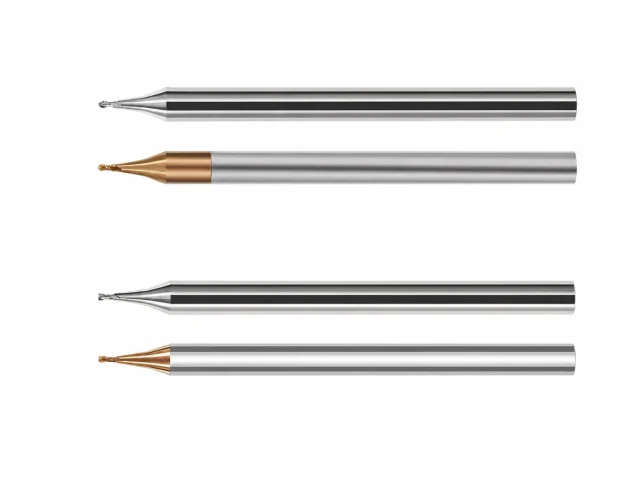
Micro tooling for stainless, cobalt chrome and titanium components, where features are measured in fractions of a millimetre and a burr is a defect.
The problem
Medical components compress a lot of difficulty into a small part. The features are fractions of a millimetre across, the materials work-harden, and a burr is not a cosmetic problem but a rejected part. At this scale the tool runout matters as much as the geometry.
What we recommend
Small features
Micro end mills from Ø0.2 mm, ground and inspected on dedicated micro machines. Runout held under 3 µm and stated on the label.
Ø0.2–3 mm · runout < 3 µm · h5
Burr-free edges
Micro corner radius geometry, where even R0.05 mm changes the failure mode and reduces the burr left at the edge.
Micro corner radius · R0.05–0.3 mm
Stainless and cobalt chrome
Ultra-fine substrate with AlCrN coating for the work-hardening alloys, and DLC where adhesion is the problem.
AlCrN / DLC · ultra-fine K20–K30
Starting cutting data
| Material | Cutting speed vc | Feed fz | Depth of cut ap |
|---|---|---|---|
| Stainless 316L | 80–140 m/min | 0.005–0.015 mm/tooth | 0.05×D |
| Cobalt chrome | 60–110 m/min | 0.004–0.012 mm/tooth | 0.04×D |
| Titanium Ti-6Al-4V | 50–90 m/min | 0.005–0.015 mm/tooth | 0.05×D |
How to specify it
- Feature size and minimum internal radius — this is usually what decides the tool diameter.
- Material and condition — annealed or work-hardened changes both the geometry and the cutting data.
- Burr acceptance — if a deburring operation is not possible, tell us and we work to the edge quality.
- Machine runout — we can supply a tool with tight runout, but a worn holder will undo it. Worth checking before we both chase the wrong problem.